

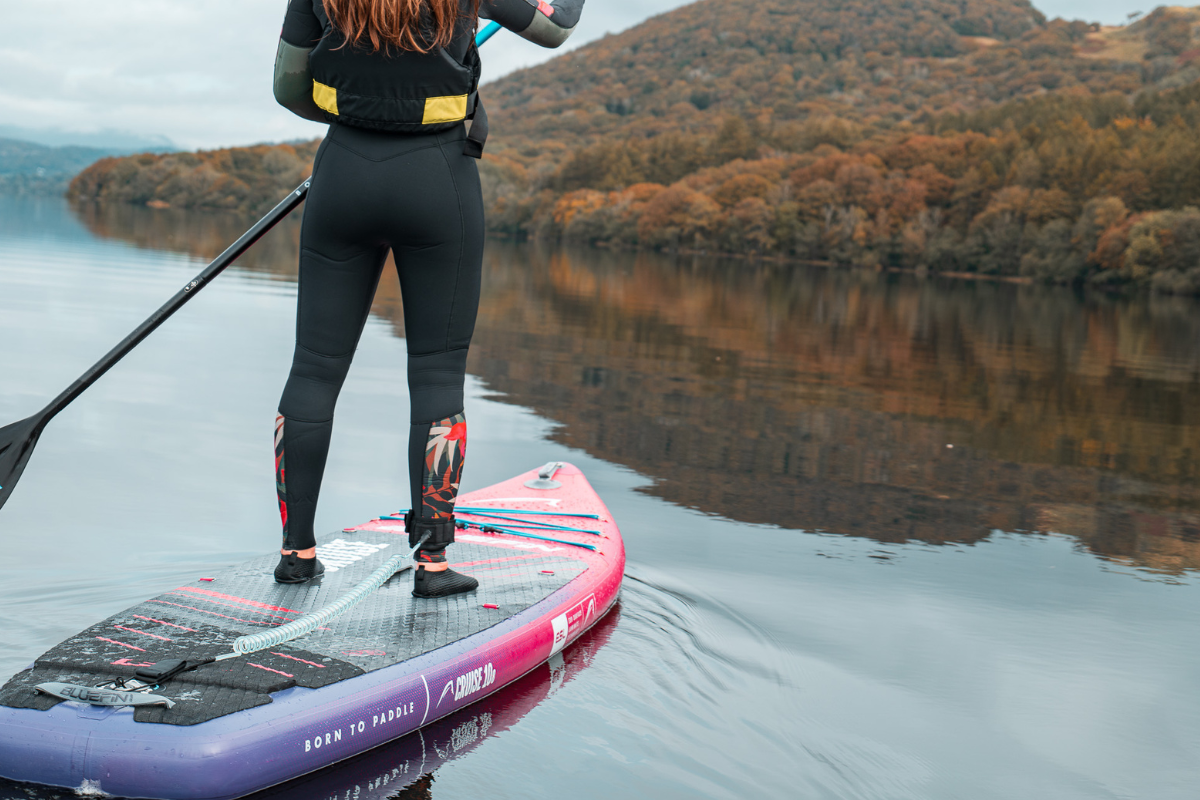

Multi-day paddleboarding adventures in Europe offer something a short afternoon paddle cannot: the chance to travel through a landscape rather than simply explore one launch point.
Your board becomes your transport, luggage carrier and route into quieter parts of the continent. One day might take you between wooded German lakes. Another could involve following a French river past limestone cliffs, vineyards and riverside villages. Further north, a carefully planned journey can connect sheltered islands in a Swedish archipelago.
The appeal is obvious, but an overnight SUP trip requires more than strapping a tent to the front of your board. Weather, water access, camping rules, equipment weight and emergency planning all become more important once you paddle beyond an easy walk back to the car.
This guide explains how to plan a European SUP adventure that is ambitious enough to feel rewarding without becoming unnecessarily risky.
What Is a Multi-Day Paddleboarding Adventure?
A multi-day SUP adventure is any journey involving at least one overnight stop away from the original launch point. It might be completely self-supported, with camping equipment and food carried on the board, or supported by campsites, guesthouses and luggage transfers.
There are three main formats.
Self-Supported SUP Camping
A self-supported paddler carries everything required for the journey, including:
• Shelter and sleeping equipment
• Food, cooking equipment and water
• Dry clothing
• Navigation and communication devices
• Repair and emergency equipment
This format gives you the most independence, but every kilogram affects stability, acceleration and handling. It is best suited to paddlers who already understand their board, equipment and chosen environment.
Campsite-to-Campsite Touring
This is often the best introduction to paddleboard camping in Europe. You still carry your essential equipment, but your route connects established campsites with drinking water, toilets and recognised landing points.
Germany’s lake districts and established paddling regions in France are particularly well suited to this style of journey because routes can be built around waterside accommodation.
Inn-to-Inn or Base-Supported Trips
An inn-to-inn route replaces the tent with guesthouses, hostels or hotels. Alternatively, you can remain in one location and complete a different point-to-point paddle each day using road or rail transfers.
This approach reduces the amount carried on the board and works particularly well for:
• First-time touring paddlers
• Couples with different ability levels
• Trips during unpredictable shoulder-season weather
• Routes with difficult portages
• Urban rivers and heavily regulated waterways
You do not need to camp wild for a journey to count as an adventure. A well-designed supported route can provide more time on the water and fewer logistical distractions.
Best Multi-Day Paddleboarding Adventures in Europe
There is no single best destination. The right choice depends on whether you prefer lakes, flowing rivers, canals or coastal water.
The following ideas should be treated as starting points rather than fixed itineraries. Access conditions, water levels, navigation restrictions and campsite availability must be confirmed directly with local authorities and accommodation providers before departure.
Destination |
Suggested Trip Length |
Best For |
Main Planning Challenge |
Mecklenburg Lake District, Germany |
3–7 days |
Connected lakes, campsites and flexible routes |
Wind exposure and motorboat traffic |
Dordogne Valley, France |
2–5 days |
Downstream touring and riverside camping |
Flow levels, landing access and summer crowds |
Stockholm or Sankt Anna Archipelago, Sweden |
3–7 days |
Island camping and wilderness scenery |
Navigation, sea conditions and exposed crossings |
Friesland, Netherlands |
2–5 days |
Canals, villages and inn-to-inn touring |
Boat traffic, bridges and local access rules |
Lake Constance |
2–4 days |
Cross-border touring with frequent services |
Wind, ferry traffic and different national rules |
Lake Most na Soči, Slovenia |
2–3 days |
Alpine scenery and base-supported paddling |
Cold water and nearby river hazards |
Norfolk Broads, England |
2–4 days |
Sheltered waterways and campsite touring |
Licensing, boat traffic and portages |

Mecklenburg Lake District, Germany
The Mecklenburgische Seenplatte is one of the strongest options for a first multi-day European paddleboarding journey. Its network of lakes, channels, small settlements and paddler-friendly campsites makes it possible to create anything from a long weekend to a full week on the water.
The area is popular for multi-day canoe and kayak touring, which means there is already useful infrastructure for travelling paddlers. However, conditions are not always uniformly sheltered. Larger lakes can develop short, uncomfortable waves, while some channels carry considerable motorboat traffic.
A sensible first route should:
Link smaller lakes rather than cross the widest open water.
Include a campsite or landing option every day.
Keep an alternative route available when the wind increases.
Avoid relying on one long crossing to reach the night’s accommodation.
Germany is also a practical destination for paddlers travelling with inflatable equipment. Rail connections can reduce the need for a car, while a packed board can be carried between stations, campsites and access points.
The Dordogne Valley, France
The Dordogne combines attractive scenery with relatively straightforward downstream logistics. Depending on the chosen section, paddlers can pass cliffs, woodland, historic villages and beaches while staying at established campsites near the river.
The region already supports multi-day canoe journeys, making it a useful starting point for SUP planning. However, a canoe itinerary is not automatically a safe paddleboarding itinerary. Board handling, flow, wind, obstructions and landing access still need to be assessed independently.
The Dordogne is best approached as a campsite-supported journey. Book accommodation in advance during the summer season and confirm that each site has a practical landing nearby.
Sweden’s Sheltered Archipelagos
Sweden offers some of Europe’s most memorable paddle camping, particularly around sheltered island groups such as Sankt Anna and parts of the Stockholm Archipelago.
The country’s Right of Public Access supports responsible access to much of the landscape, including limited camping away from homes and cultivated land. It does not provide permission to camp anywhere without judgement. Paddlers must respect private property, wildlife, fire restrictions and protected areas.
Archipelago touring should be considered coastal paddling, even when islands create an impression of shelter. Wind direction, fetch, visibility, shipping channels and cold water can quickly turn a simple crossing into a serious undertaking.
Less experienced paddlers should choose:
• Short gaps between islands
• Routes with several alternative landing points
• Stable weather windows
• Clearly identified sheltered camps
• A local guide for their first journey
Friesland, Netherlands
Friesland’s canals, lakes and waterside settlements create excellent conditions for a slower inn-to-inn adventure. Instead of carrying full camping equipment, paddlers can travel between villages while using small hotels, guesthouses or organised campsites.
The main challenge is not wilderness exposure but sharing the water with other craft. Narrow channels, bridges, powered boats and larger lakes require awareness and predictable movement.
A Friesland route suits paddlers who enjoy cultural stops, cafés and historic settlements as much as remote scenery. It is also a practical choice when one member of the group does not want to camp.
Lake Constance
Lake Constance sits between Germany, Austria and Switzerland, offering mountain views, established towns and extensive transport connections.
A multi-day route does not need to cross the centre of the lake. In most cases, a shoreline journey with short stages is a better option. This provides easier landing access and more opportunities to stop when conditions change.
Because the lake borders several countries, do not assume that equipment and navigation requirements remain identical throughout the route. Check local rules for every section, especially where the planned journey crosses an international boundary.
Lake Most na Soči and Slovenia
Slovenia is widely associated with the emerald water of the Soča Valley, but much of the river demands moving-water knowledge.
Beginners planning several days in the region should use Lake Most na Soči as a base, combining shorter touring days with hiking or professionally guided paddles. Do not enter whitewater or unfamiliar moving water simply because another section of the valley appears calm.
This is better viewed as a multi-day paddleboarding holiday than a continuous self-supported expedition.
How to Plan Multi-Day Paddleboarding Adventures in Europe
Start With Conditions You Already Understand
Your first overnight SUP trip should take place on water comparable to your regular paddling environment. Someone experienced on calm lakes is not automatically ready for:
• Tidal estuaries
• Alpine rivers
• Exposed sea crossings
• Fast commercial waterways
• Large lakes in strong wind
Distance does not define difficulty. A 12-kilometre open-water stage in a crosswind may be considerably harder than a 25-kilometre journey on a sheltered canal.
Set a Realistic Daily Distance
A useful planning range for a first trip is approximately 10 to 15 kilometres per day on sheltered water. Experienced touring paddlers may comfortably travel further, but daily mileage should account for more than average paddling speed.
Allow time for:
• Packing and securing equipment
• Launching and landing
• Portaging around obstacles
• Food and rest stops
• Navigation checks
• Photography and wildlife observation
• Delays caused by wind or boat traffic
• Setting up camp before dark
Do not build an itinerary that only works when every stage goes perfectly.
Work Backwards From Safe Overnight Stops
Identify your accommodation before deciding the exact route. Each overnight stop should have:
A legal and practical landing point.
Permission to camp or a confirmed booking.
A safe place to store or secure the board.
Drinking water or a reliable refill plan.
An alternative arrival point nearby.
Road, rail or foot access in an emergency.
Mark these points on both a digital map and an offline backup.
Add Escape Routes
Every stage needs at least one realistic way to leave the water early. A beach on a map may be inaccessible because of private property, cliffs, mud, reeds or a steep bank.
Good escape points include:
• Public slipways
• Marinas that permit small craft
• Campsites
• Railway towns
• Road bridges with safe banks
• Recognised canoe or kayak landings
An escape point is only useful when you know how to continue from it. Check local buses, railway stations, taxi coverage and walking distances before departure.

Choosing the Right Paddleboard for a Multi-Day Trip
The best expedition board is not necessarily the fastest model. It must remain stable when loaded, track efficiently and provide dependable attachment points for equipment.
Before departure, calculate the combined weight of:
• The paddler
• Clothing and footwear
• Water
• Food
• Shelter and sleeping equipment
• Dry bags
• Safety equipment
• Optional camera or fishing equipment
Compare the total with the board manufacturer’s stated capacity. Leave a sensible margin rather than loading the board to its absolute limit.
Stability Versus Speed
A longer, narrower touring board may cover distance efficiently, but it can become less forgiving when carrying bulky equipment or dealing with side winds. A broader all-round board may be slower, yet more comfortable during a first overnight journey.
Choose according to real conditions and experience, not headline speed.
Why Inflatable SUPs Work Well for European Touring
Inflatable boards offer several practical advantages for cross-border adventures:
• They can travel in a car boot or train luggage area.
• They are easier to store in hotels and campsites.
• They can be carried around locks and other obstacles.
• They reduce the need for roof racks.
• They allow point-to-point journeys using public transport.
The trade-off is that the paddler must carry a pump and repair equipment and protect the board from sharp landing surfaces.
Bluefin SUP Options for Multi-Day Adventures
Test the Fully Loaded Board Before Travelling
Do not discover how your board handles expedition weight on the first morning of the actual journey.
Complete at least one local practice paddle with:
• The same dry bags
• The expected water load
• Your camping equipment
• The clothing you intend to wear
• The selected fin and leash system
Practise paddling into the wind, turning, kneeling, landing and getting back onto the board after falling in.
A stable unloaded board can feel completely different once its nose and tail are covered with luggage.
Multi-Day SUP Packing List
Essential Paddleboarding Equipment
• Inflatable SUP suitable for the total load
• Paddle
• Correct fin and any required fitting tools
• Pump
• Manufacturer-compatible repair kit
• Personal flotation device or buoyancy aid
• Correct leash for the environment
• Waterproof phone pouch worn on your body
• Whistle
• Spare paddle or compact breakdown paddle on remote routes
Your phone should remain attached to you rather than stored inside luggage fixed to the board. If you become separated from your SUP, emergency communication packed on the board may no longer be accessible.
Camping and Sleeping Equipment
• Lightweight tent, bivvy or approved shelter
• Sleeping bag suited to overnight temperatures
• Insulated sleeping mat
• Head torch
• Small camping towel
• Earplugs
• Lightweight seating pad
• Waste bags
Split essential sleeping equipment between waterproof layers. A sleeping bag should sit inside its own waterproof liner before being placed in the main dry bag.
Clothing
Pack for immersion and changing weather rather than daytime air temperature alone.
Your clothing system may include:
• Wetsuit, drysuit or technical paddling layers
• Lightweight waterproof jacket
• Insulating mid-layer
• Warm camp clothing
• Spare base layer
• Two pairs of paddling socks
• Suitable water footwear
• Warm hat
• Sun hat
• UV protection
• Lightweight gloves
Keep one complete set of camp clothing dry at all times. Never wear it on the board unless your paddling kit has become unsafe or unusable.
Food and Water
Choose food that is compact, simple to prepare and familiar to your body. An expedition is not the ideal time to test a completely new diet.
A simple menu could include:
Porridge, dried fruit and nut butter for breakfast.
Wraps, cheese or durable spreads for lunch.
Couscous, noodles or dehydrated meals in the evening.
Nuts, fruit bars and savoury snacks during the day.
Plan confirmed drinking-water refills wherever possible. Do not assume clear lake or river water is safe to drink. Carry an appropriate treatment method as a backup and understand its limitations.
Navigation and Emergency Equipment
• Offline mapping on your phone
• Waterproof paper map or route notes
• Compass
• Portable power bank
• Charging cables in a dry pouch
• First-aid kit
• Emergency shelter
• Personal medication
• Identification and insurance details
• Cash and payment card
• Emergency contact information
• List of nearby transport points
For more remote routes, consider a satellite communication device. Mobile coverage can disappear in mountain valleys, forests and island groups.
Board Repair Kit
A basic repair system should include:
• Manufacturer-approved patches
• Suitable adhesive where applicable
• Valve tool
• Waterproof tape for temporary repairs
• Small cloth for drying the repair area
• Spare fin hardware if your setup requires it
Know how to use the kit before departure. Carrying tools without understanding the repair process creates false confidence.
How to Pack a Paddleboard for Touring
Keep Heavy Equipment Low and Central
Place water, food and dense equipment close to the board’s centre. Lightweight items such as sleeping equipment can sit further forward or behind the paddler.
Avoid building a tall stack on the nose. It catches wind, obstructs your view and can make remounting difficult.
Use Several Dry Bags
One large bag may seem convenient, but several smaller bags are easier to balance and organise.
A practical system is:
• Front bag: shelter and sleeping system
• Centre bag: food, water and cooking equipment
• Rear bag: spare clothing and camp items
• Small personal bag: phone, first aid, identification and snacks
Critical emergency equipment should remain accessible without unpacking the entire board.
Secure Every Item Independently
Do not rely on one loose cargo net. Use appropriate straps or bungees and check that bags cannot slide into the water during a fall.
After packing, turn the board onto its side on land. If equipment immediately shifts, it is not ready for moving water, waves or a difficult landing.
Safety for Multi-Day Paddleboarding Adventures in Europe
Check More Than the Weather Symbol
Review:
• Wind speed
• Wind direction
• Gust strength
• Rain and thunderstorms
• Air temperature
• Water temperature
• River level and flow
• Tide times
• Wave height
• Visibility
The direction matters as much as the speed. A moderate tailwind may appear helpful but could make landing difficult or leave you unable to reverse the route.
Never treat an offshore wind as a free ride. It can rapidly carry a lightweight paddleboard away from land.
Choose the Correct Leash
A leash suitable for calm open water may become hazardous in flowing water where it can catch around branches, posts or other obstacles.
Moving water, tidal rivers and estuaries may require a properly fitted quick-release waist system. An ankle leash should not be treated as a universal solution.
Seek professional instruction before touring on moving water. Owning the correct leash does not replace the ability to identify entrapment hazards.
Understand Local Rules
Europe does not have one set of paddleboarding regulations covering every country and waterway.
Depending on the location, you may need to investigate:
• Waterway licences or permits
• Mandatory flotation equipment
• Restricted conservation areas
• Navigation channels
• Lock and weir portages
• Camping permissions
• Fire restrictions
• Seasonal wildlife closures
• Border-crossing requirements
Some managed waterways require a licence, while others restrict access at certain times of year. Locks, weirs and hydroelectric structures may require a compulsory portage.
Check the authority responsible for each individual lake, river, canal or coastal area shortly before travelling. Rules displayed in an old forum post may no longer be valid.
Share a Float Plan
Give a trusted person:
• Your route
• Planned launch and landing points
• Campsite details
• Group names and phone numbers
• Board colours
• Vehicle information
• Daily check-in time
• Instructions for raising concern
Send an update whenever the route changes. A plan left with someone at home is only useful when they know what to do if you miss a check-in.
Common Multi-Day SUP Mistakes
Carrying Too Much Equipment
Beginners often pack for every possible comfort. The result is an unstable board, slow progress and exhausting portages.
Complete a full kit review and remove duplicate clothing, oversized toiletries, unnecessary electronics and bulky cooking equipment.
Planning Every Day at Maximum Distance
Ignoring Total Load Capacity
The relevant figure is not just the paddler’s body weight. Food, water and camping equipment can add a substantial load.
A board operating close to its limit may sit lower, turn slowly and allow more water across the deck.
Testing New Equipment During the Trip
Depending Entirely on a Phone
Strapping the Phone to the Board
Assuming Wild Camping Is Allowed
Camping regulations vary considerably across Europe. Access rights in Sweden are not a model for every other country.
Use recognised campsites unless you have confirmed that low-impact overnight camping is permitted at the exact location.
Continuing Because Accommodation Is Booked
A Sample Three-Day Paddleboarding Itinerary
Day One: Short Introduction Stage
Target distance: 8–12 kilometres
Launch early enough to avoid rushing, but allow time to resolve packing problems. Keep the first stage short and use it to assess board trim, group pace and any pressure points caused by equipment.
Stop after the first hour to:
• Retighten luggage
• Check for water inside dry bags
• Adjust paddle length
• Review the forecast
• Confirm the landing location
Arrive at camp with enough daylight to dry equipment and make changes.
Day Two: Main Touring Stage
Target distance: 12–18 kilometres
This is the longest planned day, but it should include at least two exit points. Start early if afternoon winds are common in the area.
Take regular short breaks rather than one long stop that allows the body to become cold and stiff. Eat before energy levels noticeably fall.
Day Three: Flexible Final Stage
Target distance: 8–15 kilometres
Keep the final stage adaptable. The group may be tired, the weather may have changed and public transport may operate to a fixed timetable.
Choose between:
The full planned route.
A shorter landing with straightforward transport.
An early exit followed by a walk or local bus.
A rest morning before a short final paddle.
Finishing early and safely is better than forcing a final stage simply to match the original map.
Responsible Paddleboard Camping
Multi-day touring creates a close relationship with the places you travel through. It also creates opportunities to disturb shorelines, wildlife and local communities.
Follow a simple low-impact approach:
• Use established landing places where available.
• Avoid reed beds and nesting areas.
• Keep noise low near homes and campsites.
• Carry all waste away from the water.
• Use toilets rather than contaminating shorelines.
• Follow local fire restrictions.
• Do not damage trees to secure equipment.
• Avoid disposable paddling products where durable alternatives exist.
Choosing equipment designed for repeated use is part of responsible travel. Bluefin’s sustainability approach includes efforts to reduce environmental impact, extend product life and encourage more considered ownership.
Learn more about Bluefin’s Eco-Positive approach:
A durable board is not sustainable merely because it lasts a long time. Owners also need to maintain it, repair minor damage and avoid replacing equipment unnecessarily.
Final Multi-Day SUP Planning Checklist
Before leaving home, confirm that you have:
Tested the fully loaded board in realistic conditions.
Checked the total paddler and equipment weight.
Confirmed water access and overnight accommodation.
Researched licences, restrictions and camping rules.
Identified daily escape points.
Downloaded offline maps.
Shared a route and check-in plan.
Packed a buoyancy aid and environment-appropriate leash.
Protected communication equipment from water.
Checked wind, water level, tides and temperature.
Packed repair and first-aid equipment.
Created a shorter alternative for every stage.
Confirmed return transport.
Allowed sufficient time to stop or abandon the route.

Summary
The best multi-day paddleboarding adventures in Europe are not necessarily the most remote or demanding. They are the journeys where the route, board, equipment and paddler are properly matched.
Germany’s Mecklenburg Lake District is an excellent choice for connected lakes and campsite touring. France’s Dordogne offers supported downstream journeys, while Sweden provides greater independence for experienced coastal paddlers who understand its access responsibilities. The Netherlands, Lake Constance and Slovenia also provide strong alternatives for paddlers who prefer accommodation-based or base-supported travel.
For a successful first expedition:
• Keep daily distances conservative.
• Use established campsites.
• Test the board with its full load.
• Plan escape points before launch.
• Carry communication equipment on your body.
• Treat wind and cold water seriously.
• Check regulations for every waterway.
• Be willing to shorten or cancel a stage.
A multi-day journey should feel like a progression from your existing paddling, not a leap into conditions you have never encountered. Plan carefully, travel lightly and leave enough flexibility to enjoy the landscape rather than racing through it.
Delen:
Where to Paddleboard in Europe This Week: 5 Weather-Led Picks
Paddleboarding for Mental Health: Why Water + Sun Matter