

Table Of Contents
Europe's paddleboarding season does not finish when the summer holidays end.
In fact, for anyone searching for quiet paddleboarding destinations Europe can become more appealing in September and early autumn than it is during the height of July and August.
Mountain lakes begin reflecting forests turning from green to gold. Mediterranean coastlines gradually lose their peak-season crowds. Campsites become calmer, waterside towns settle into a slower rhythm and popular launch points can feel considerably more relaxed.
Germany is particularly rewarding at this time of year, with an enormous variety of inland lakes and connected waterways, but excellent post-summer SUP options extend from France and Slovenia to Croatia.
The trade-off is that autumn paddleboarding in Europe requires flexible planning. Conditions vary dramatically between an Alpine lake, a German inland waterway and the Adriatic coast.
The aim should not simply be finding warm weather.
It should be finding the right water on the right day.

Why Look for Quiet Paddleboarding Destinations in Europe After Summer?
Peak summer has obvious benefits, including long days and warmer temperatures, but it also brings crowded beaches, busy rental centres, more recreational boat traffic and intense heat in southern destinations.
Autumn changes the balance.
For travelling paddlers, post-summer trips can offer:
Quieter shorelines and launching areas once European school holidays finish.
Cooler temperatures for longer touring sessions.
Dramatic autumn colours around inland lakes.
Less pressure on campsites, hotels and popular outdoor destinations.
More opportunities for slow, nature-focused paddling.
Pleasant late-season conditions in parts of southern Europe.
There is another advantage for inflatable SUP owners: you are not dependent on seasonal hire centres remaining open.
Pack your own board and you can base your paddling around the best weather window rather than somebody else's opening hours.
What Makes a Good European Autumn SUP Destination?
Europe is far too varied for one set of conditions to describe every location.
September beside the Baltic feels very different from September on the Croatian coast.
Instead of looking only at average temperatures, consider the actual characteristics of the water.
Before travelling, research:
Local SUP access and navigation regulations.
Permit or registration requirements.
Water temperature.
Prevailing winds and local weather patterns.
Commercial boat traffic.
Protected areas or wildlife restrictions.
Suitable access and exit points.
Whether local facilities remain open after summer.
Regulations can change across national and even regional borders, so check current official guidance before launching rather than relying entirely on an old travel blog or social media post.
1. Mecklenburg Lake District, Germany
For paddlers who associate Germany primarily with rivers and Alpine lakes, Mecklenburg can be a revelation.
The Mecklenburg Lake District forms part of a vast landscape of lakes, channels and waterways in north-eastern Germany. Official regional tourism information promotes SUP across the Lake District, including routes through calm inland waters and natural channels. Mecklenburg-Vorpommern as a whole has more than 2,000 lakes.
That scale makes it possible to build a paddling trip around the conditions rather than committing to a single piece of exposed water.
Why Mecklenburg Works After Peak Season
Autumn feels particularly suited to this landscape.
Forested shores begin changing colour, mist can sit low over smaller lakes and the interconnected waterways provide a strong sense of exploration without requiring exposed coastal paddling.
Germany's shoulder season also suits touring paddlers extremely well. Instead of spending the day around one beach, you can plan point-to-point journeys or explore channels linking different bodies of water.
Best For
Planning Tip
Do not assume every lake has identical access rules.
Research the specific water you intend to paddle, including conservation areas and local navigation requirements.
2. Lake Constance, Germany and Austria
Lake Constance — Bodensee — provides one of Europe's most recognisable paddleboarding environments.
Shared by Germany, Austria and Switzerland, this enormous lake combines Alpine views, attractive shoreline towns and long stretches of water that can look deceptively calm from land.
For EU-focused trips, the German and Austrian shores provide numerous possibilities.
Why Go After Summer?
September can bring a useful balance: the busiest holiday period begins to ease while there can still be plenty of usable daylight for well-planned sessions.
The Lake Constance tourism network continues to list SUP among the region's water activities, with some operators running into September.
The scale of the lake deserves respect.
Paddlers must account for commercial vessels, wind and open-water conditions. Guidance published for SUP users at Lake Constance advises keeping clear of harbour entrances and passenger landing areas and states that paddlers travelling more than 300 metres from shore must carry an appropriate flotation device meeting the relevant standard.
Best For
Smart Autumn Approach
You do not need to cross Lake Constance to experience it properly.
A carefully planned shoreline paddle can provide exceptional mountain views while reducing unnecessary exposure.
3. Lake Annecy, France
Lake Annecy is famous for turquoise water surrounded by mountains — and that popularity means summer can be busy.
Autumn provides another option.
The official Lake Annecy tourist office describes stand-up paddleboarding as an activity that can be enjoyed across the seasons and specifically promotes the wider destination through autumn.
That makes Annecy one of the clearest examples of a European destination where waiting until after peak season can improve the atmosphere without removing the main reason you came.
The lake and mountains are still there.
There are simply fewer summer holidaymakers sharing them.
Best For
Make the Most of the Morning
Autumn mornings can bring beautiful light and reflective water, but visibility needs to form part of your safety decision.
If mist significantly reduces what you can see — or how easily other vessels can see you — wait.
Photogenic conditions and sensible paddling conditions are not always the same thing.
4. Lake Bohinj, Slovenia
Lake Bohinj has almost everything paddlers imagine when planning an Alpine SUP trip: clear water, steep mountains, forested shores and a relatively natural landscape.
Its location within the protected environment of Triglav National Park makes responsible access particularly important.
Current local regulations explicitly apply to stand-up paddleboards. Lake navigation is permitted throughout the year, but paddlers must use designated entry and exit points, and a permit system applies to relevant craft.
Restrictions also protect bathing areas close to shore.
Why Autumn Suits Bohinj
Summer is beautiful, but the lake can attract significant visitor numbers.
After the main holiday period, the atmosphere can become noticeably calmer while the surrounding forest begins changing colour.
The result is a destination that feels made for slow, deliberate paddleboarding rather than simply chasing distance.
Best For
Respect the Access System
Do not search for an unofficial empty beach simply because it looks more convenient.
Bohinj's designated access points form part of a broader system designed to protect a sensitive environment.
Responsible SUP travel means working with those protections rather than trying to get around them.
5. Istria, Croatia
Not every autumn paddle has to involve cold mountain water.
If you want to extend the feeling of summer into September, Croatia's Istrian peninsula offers a compelling alternative.
Rocky headlands, coves and clear Adriatic water provide a completely different type of SUP experience from the inland lakes farther north.
The Istria Tourist Board continues to promote the region heavily through September and into autumn, with outdoor activities forming an important part of the destination beyond its beaches.
Why Istria After Peak Season?
Summer temperatures and visitor numbers can both be intense.
Once August ends, the coast can feel considerably more relaxed while still retaining the character of a Mediterranean trip.
Areas around Pula, Premantura and the wider southern Istrian coastline provide plenty of visual interest for experienced coastal paddlers.
Best For
Coastal Conditions Come First
The Adriatic may look inviting, but sea paddling introduces considerations that do not exist on a small sheltered lake.
Wind direction, swell, currents and safe landing points all matter.
Never let warm sunshine convince you to ignore the sea forecast.
If conditions are wrong, paddle another day.

Europe's Quiet Autumn SUP Destinations Compared
Destination |
Country |
Best For |
Post-Summer Appeal |
Main Consideration |
Mecklenburg Lake District |
Germany |
Touring and exploration |
Forests, channels and extensive inland water |
Local access rules |
Lake Constance |
Germany/Austria |
Big-lake adventures |
Alpine scenery and lakeside touring |
Wind and commercial traffic |
Lake Annecy |
France |
Scenic SUP weekends |
Mountain views with fewer summer crowds |
Visibility and open water |
Lake Bohinj |
Slovenia |
Nature and Alpine scenery |
Protected landscape and autumn colour |
Permits and designated access |
Istria |
Croatia |
Coastal paddling |
Extended Mediterranean season |
Wind, swell and coastal exposure |
Planning an Autumn SUP Road Trip Through Europe
Inflatable paddleboards are particularly useful for European travel because they allow you to keep several destinations open until you know what the weather is doing.
That flexibility matters.
Imagine planning a September trip through Germany, Austria and Slovenia. Instead of deciding months ahead that you must paddle one particular lake on Tuesday morning, build several possibilities into the itinerary.
Weather should choose the paddling day. Your itinerary should accommodate it.
A simple approach works well:
Check the longer-range forecast when planning your route.
Make final paddling decisions using detailed local forecasts closer to launch.
Prioritise sheltered water during unsettled periods.
Avoid making non-refundable plans around one specific SUP session.
Keep hiking, cycling or sightseeing alternatives ready.
Check seasonal campsite and accommodation opening dates.
Confirm local launch and permit requirements before arrival.
This type of travel is less about collecting destinations and more about having enough flexibility to enjoy each place safely.
Autumn Paddleboarding Safety Across Europe
The most significant difference after peak season is not the number of people on the water.
It is your margin for error.
Water begins cooling, evenings draw in and some locations become much quieter.
What to Carry
A well-prepared autumn setup may include:
An appropriate PFD or buoyancy aid.
Thermal protection suitable for the water temperature.
Dry clothing in a properly sealed dry bag.
Waterproof communication.
Drinking water and food.
Basic board repair equipment.
A suitable leash system for the environment.
Navigation information where required.
Emergency contact information.
A light when there is any possibility of returning close to dusk.
Local legal requirements always take priority, so research the destination before travelling.
A setup that meets your usual home-water routine may not meet the regulations somewhere else in Europe.
Common Mistakes When Paddleboarding Europe After Summer
Assuming Southern Europe Means Warm Water
Warm air does not necessarily mean warm water, particularly on deep lakes or mountain-fed waterways.
Choose clothing with immersion in mind.
Planning Too Much Distance
A new destination creates a temptation to see everything.
You do not need to paddle the entire lake to have a memorable trip.
A shorter route completed comfortably is better than a long route finished exhausted.
Relying Entirely on SUP Hire
Many European hire centres are highly seasonal.
Travelling with your own inflatable SUP gives you far more freedom once September progresses.
Forgetting Local Rules
Permits, navigation rules, protected zones and mandatory equipment vary.
Check current official information for every destination.
Treating an Empty Lake as a Safer Lake
Quiet surroundings are wonderful, but fewer people may mean less immediate assistance.
Your preparation should increase as locations become more remote.
Which Bluefin SUP Is Best for European Travel?
Bluefin Lite: For Easy Travel
If luggage space is your main concern, the Bluefin Lite is designed around a compact pack size and lightweight handling.
That makes it particularly relevant for trains, smaller cars, flights and trips where you may carry your board some distance from your accommodation.
A board that is easier to transport opens up more possibilities when your adventure extends beyond a waterside car park.
Bluefin Cruise: The Versatile European All-Rounder
For road trips involving different types of water, the Bluefin Cruise provides an all-round balance of stability, glide and manoeuvrability.
That versatility is useful if one trip might include a sheltered German lake followed by a calm Mediterranean bay.
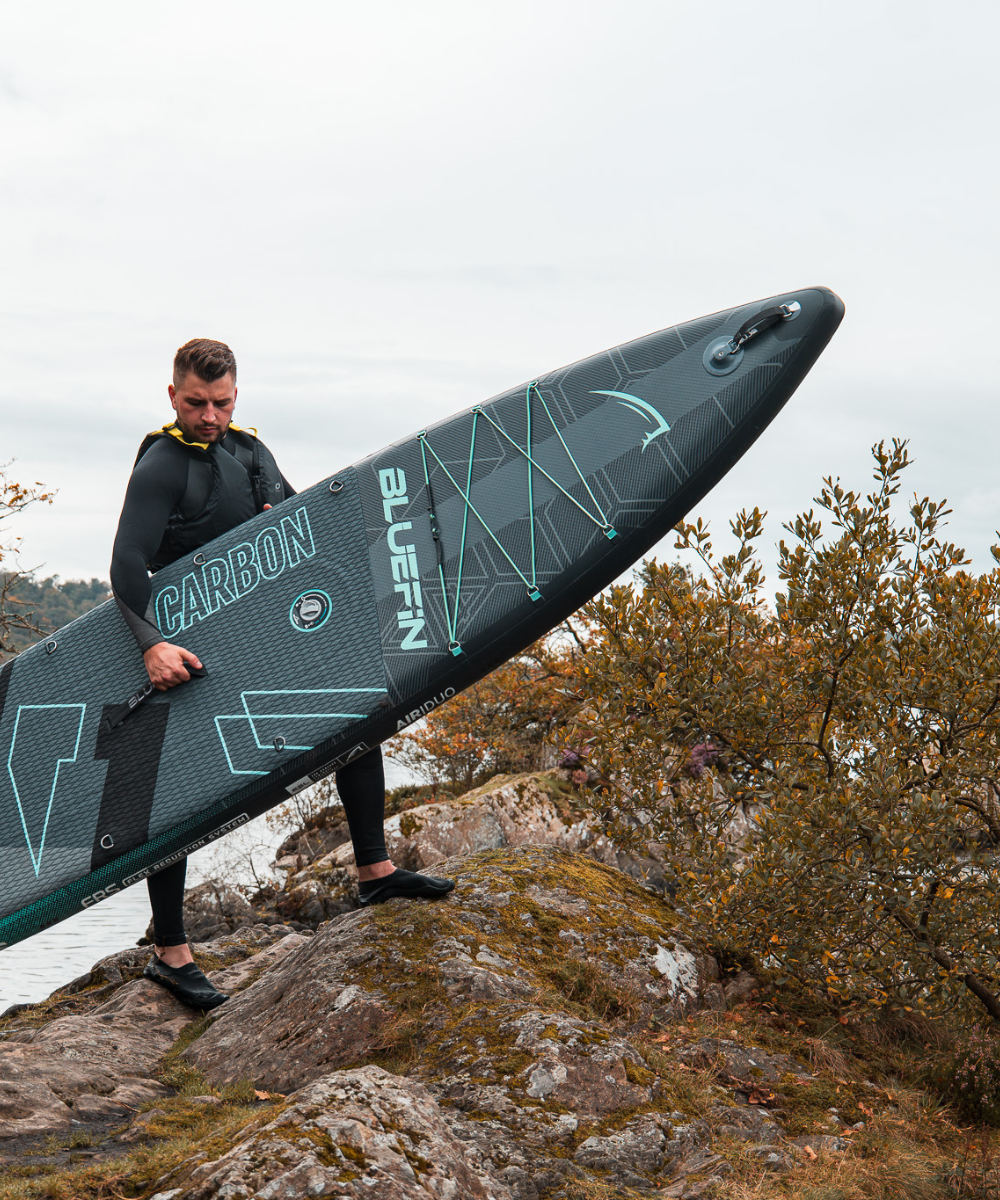
Bluefin Carbon: For Touring-Focused Paddlers
The Bluefin Carbon is aimed more towards paddlers looking for increased stiffness, control and efficient performance over longer routes.
Its dual-chamber construction also provides an additional independent air chamber.
Whatever your board, do not allow better equipment to increase your appetite for poor conditions.
Judgement matters more than specification.
Travel Responsibly Between European Waterways
Paddling several destinations in one trip creates another responsibility: your equipment moves between ecosystems.
Clean and dry your paddleboard, leash, fin, footwear and other wet equipment before entering a new waterway, particularly where local biosecurity advice requests it.
Respect reed beds, wildlife refuges, nesting areas and protected shorelines.
The quietest autumn SUP trips are often rewarding precisely because these landscapes remain relatively undisturbed.
Bluefin's Eco Positive approach focuses on reducing environmental impact through areas including recycled materials where possible, lower-plastic packaging, conservation initiatives and extending product life.
Durability also matters when travelling. Bluefin's Built to Last philosophy centres on creating boards intended for repeated adventures rather than a single summer of use.
The most sustainable adventure gear is gear you keep using.

Summary: The Best Quiet Paddleboarding Destinations in Europe
Europe does not become less interesting when summer ends.
For paddlers, it can become more interesting.
Germany's Mecklenburg Lake District offers extraordinary variety for touring and exploring. Lake Constance combines SUP with Alpine views and a cross-border road-trip atmosphere. Lake Annecy delivers classic French mountain scenery, while Lake Bohinj rewards paddlers prepared to respect its carefully protected environment. Farther south, Istria provides an opportunity to keep coastal adventures going after the main Mediterranean rush.
Each destination is different, but the same principles apply.
The best quiet paddleboarding destinations Europe offers after peak season are those where conditions, access and your ability line up on the same day.
Do not force an itinerary simply because you have travelled a long way.
Watch the weather. Stay flexible. Check regulations. Dress for the water. Choose conservative routes when conditions demand it.
Then enjoy what autumn does best: turning some of Europe's busiest outdoor destinations into slower, quieter places to explore from the water.
Find a paddleboard suited to European road trips, compact travel and longer touring adventures, then keep exploring well beyond the summer holiday season.
Compartir:
When to Upgrade Your Paddle Board: 7 Signs It’s Time
Autumn Paddleboarding Europe: Balance Work and SUP Time